Thermal surveys of five rooftop solar plants for Urbasolar, in Martinique and Guadeloupe
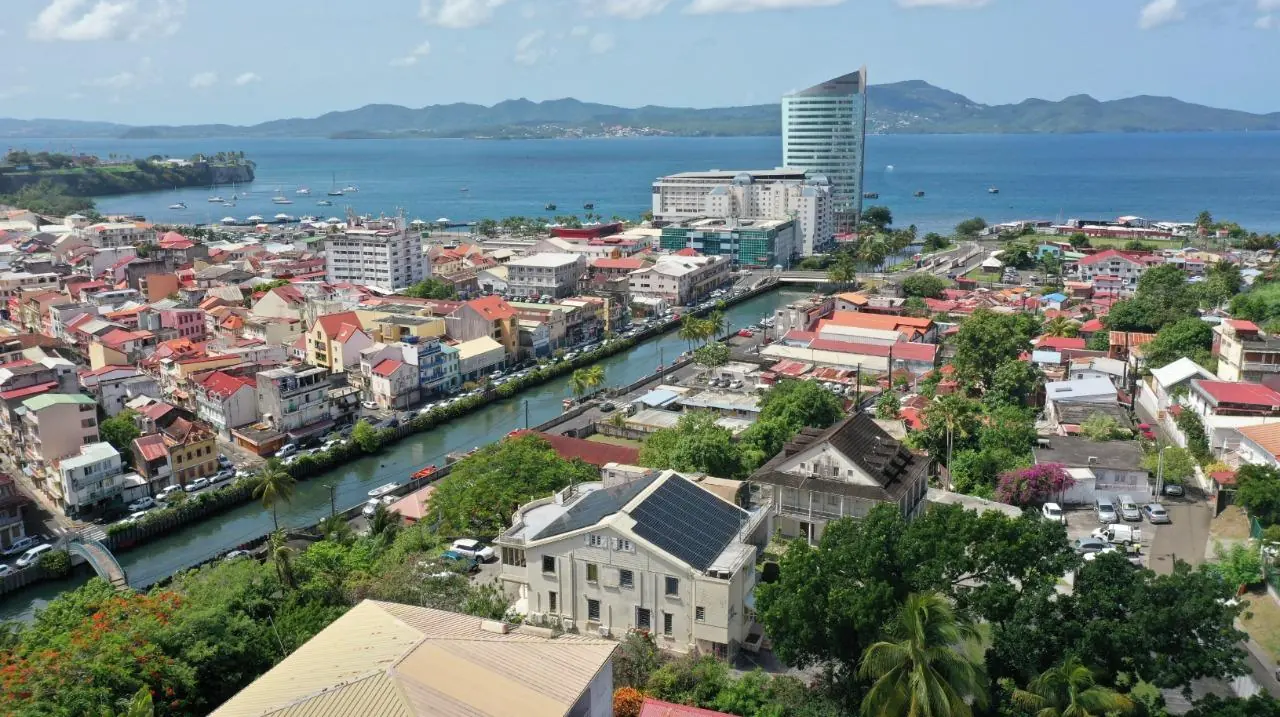
Urbasolar operates rooftop photovoltaic plants in the French Caribbean. Since March 2024 its maintenance and construction teams have entrusted us with drone thermal surveys, each time with a specific question: identify faulty strings, locate cracked modules or prepare a rewiring job. Five plants were surveyed between 2024 and 2026, four in Martinique and one in Guadeloupe.
La Trinité: 4,082 rooftop modules
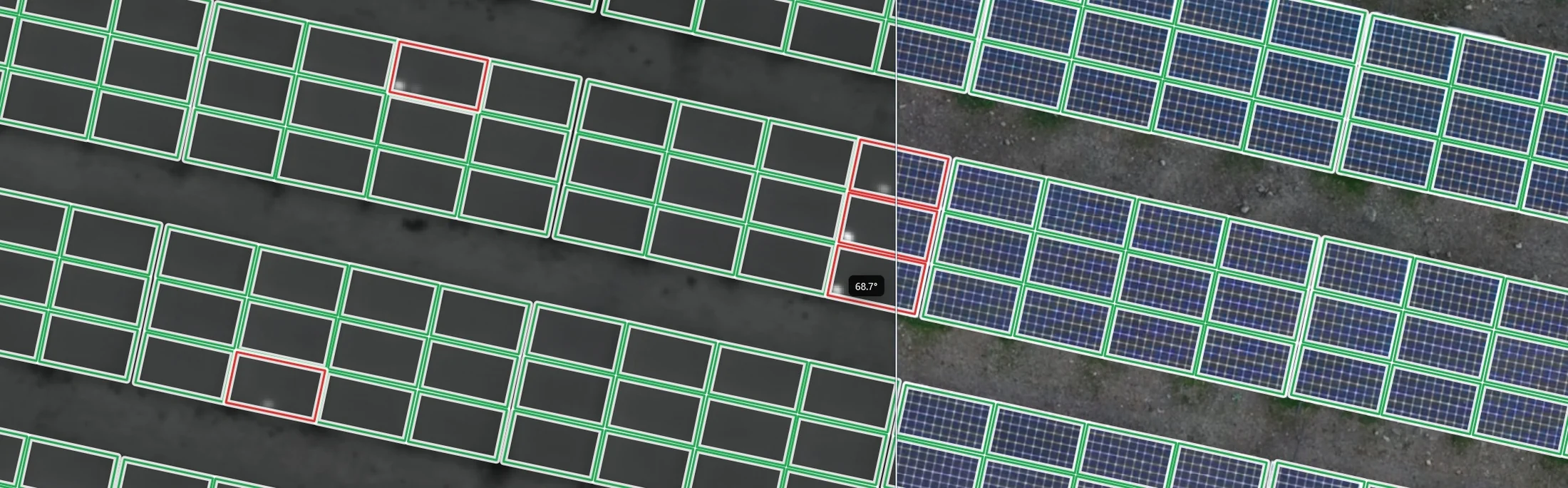
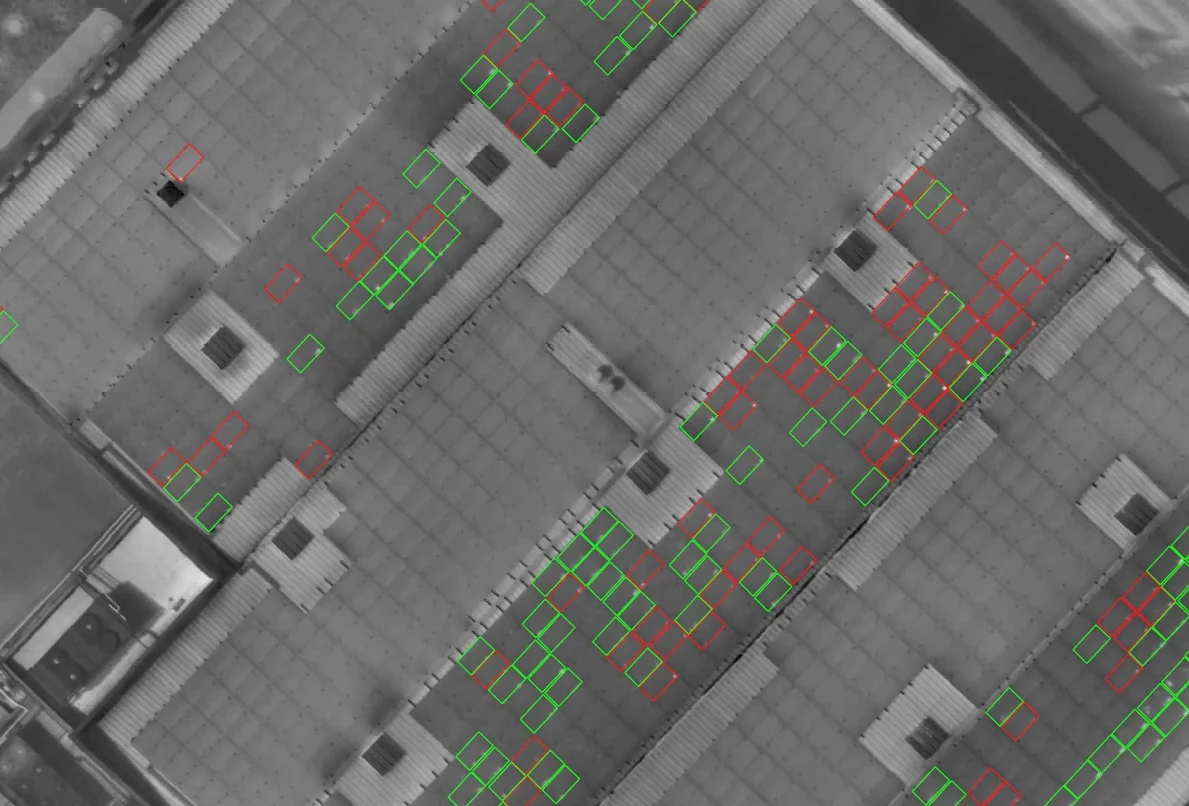
The first mission took place on 12 March 2024 in La Trinité, on a plant spread over several buildings, i.e. 10,090 m² of panels. The report lists 4,082 modules and classifies the affected ones by category: hotspots, cell constellations, module defects, cable defects and faulty strings. The report comes with a 1:500 defect plan, and the module layout plan was drawn from the orthophoto, including for a building added after the first visit.
The same day, with Urbasolar’s technician, we tested a string identification protocol we had proposed. During four flights he switched off 2 strings for the first two and 4 for the next two, allowing 10 to 15 minutes each time for thermal inertia. The technician considered that the method seemed to work, recommending that the switched-off strings be spaced well apart to avoid errors. Additional flights took place in early April and the mission was closed on 16 April 2024.
Le Lamentin: two roofs in a single morning
In June 2025 the request covered two neighbouring installations in Le Lamentin, a 491 kW depot and a 66 kW commercial building. Both roofs were flown on 27 June, between 11:00 and 12:15: 2,340 modules over 3,482 m² for the first, 300 modules over 452 m² for the second. Each report classifies the affected modules into hotspots, module defects, string defects and partial shading, with a defect plan alongside. Everything was handed over on 8 July.
Jarry: a second campaign, with the plant producing
In Jarry, Guadeloupe, the 248 kWp plant on the SOCOGAR building had modules cracked by over-tightened mounting clamps. Urbasolar wanted to know how many and where. We designed the flight plan and our Guadeloupe partner Antilles Drone flew it: visible at 35 m for 1 cm per pixel, infrared at 30 m and 1 m/s in two crossed grids, one of them along the ridge, with a manual calibration of the thermal camera above the panels at the start of the flight.
After the first visit, in late August 2025, the operator found that the plant had not been producing that day. A second campaign was therefore flown on Saturday 13 December 2025, after confirmation that all inverters were feeding in. The deliverables, including a multi-layer defect plan of the 758 modules, were handed over on 15 December.
Le Lamentin: survey before rewiring
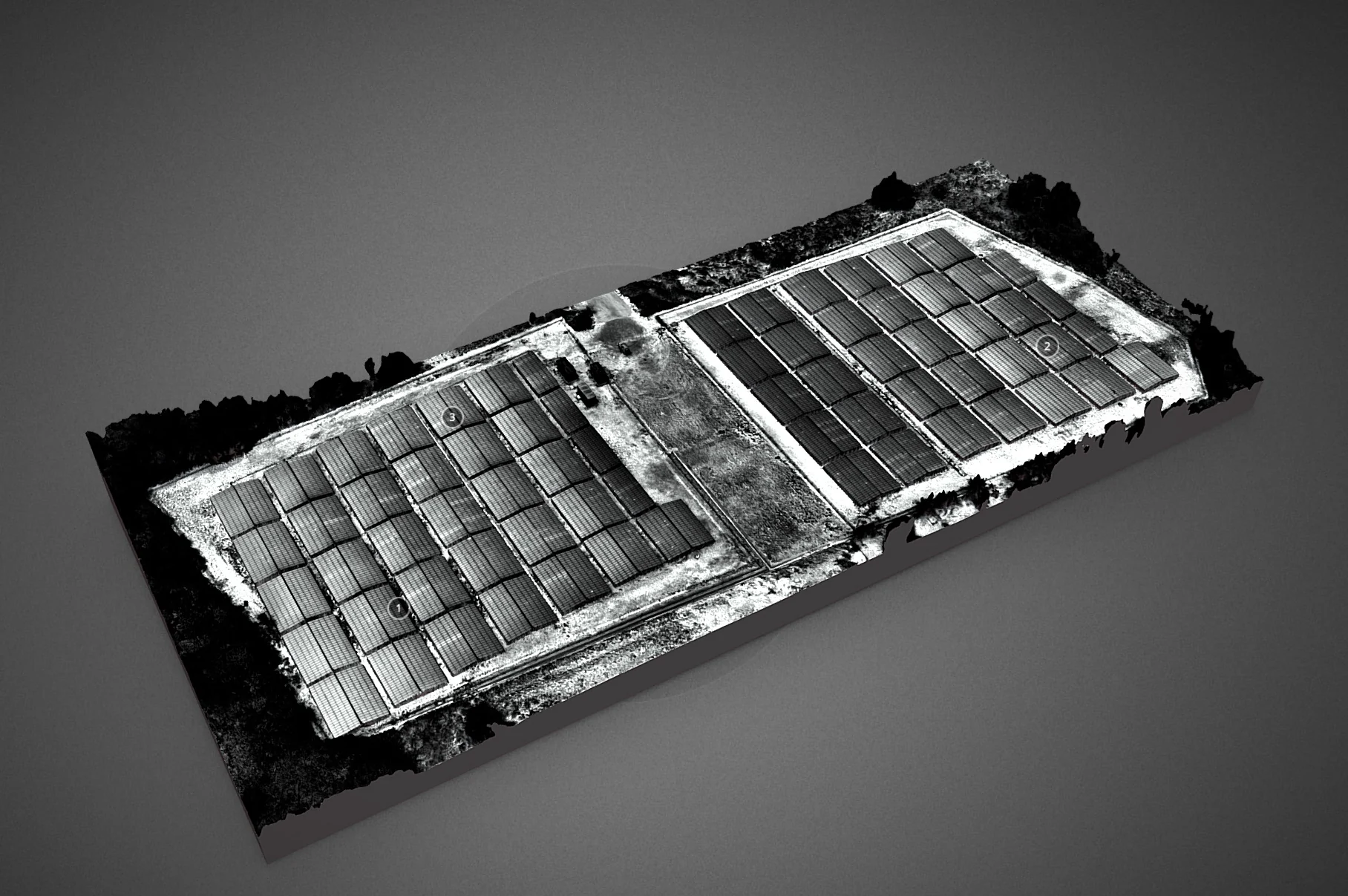
In early 2026, on another plant in Le Lamentin, about a hundred modules had been removed to install smoke-vent frames. Urbasolar needed to find the possible positions and identify the strings left incomplete, in order to redo the wiring plan. We proposed a photogrammetric survey at under 1 cm per pixel in the visible, complemented by a 3 cm thermal survey. The survey was flown on 9 February 2026; the orthophoto, the plan and an online 3D model were delivered on the 12th.
The thermal survey waited for the plant to restart, confirmed on 30 March: flight on 17 April, deliverables on the 21st. In July, at the operator’s request, the plans were also supplied in DWG format, with the orthophoto as background.
What stays the same from one plant to the next
Every mission produces the same deliverables: visible and infrared orthophotos, defects classified module by module, a report and a plan for each plant. For the second Jarry campaign as for the Le Lamentin thermal survey, the operator confirmed before the flight that the plant was producing, on 11 December 2025 and 30 March 2026.