Furnas test blocks: measuring cracks at 0.15 mm per pixel
In Aparecida de Goiânia, in the state of Goiás, the utility Furnas runs a concrete ageing station. Cubes with 80 cm sides age there in the open air: some were mixed to develop the alkali-aggregate reaction, others delayed ettringite formation, others both, and control blocks are meant to stay sound. These two reactions make the concrete of many dams swell and crack; the instrumented blocks make it possible to follow their progress under known conditions.
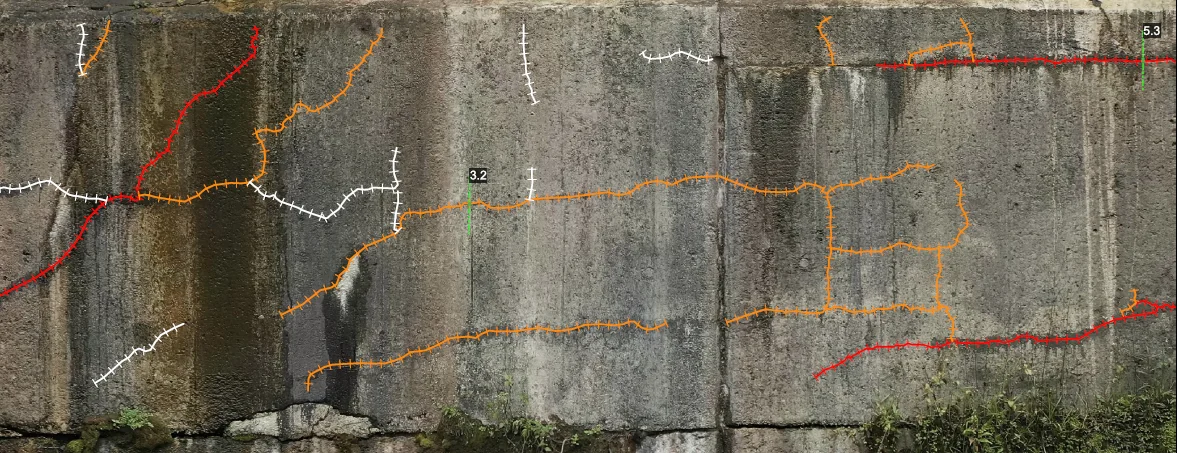
Since 2022 we have measured their cracks face by face, by close-range photogrammetry.
2022: 26 blocks at 0.25 mm per pixel
The first campaign, from 29 August to 5 September 2022, covered 14 blocks in Goiânia and 12 more in Curitiba, at LACTEC. Each face was photographed from 60 cm with the camera of an RTK drone fitted with a one-inch sensor, with at least 25 georeferenced images: 3,200 photos, 128 orthomosaics at 0.25 mm per pixel and 974 measurements. Cracks are classified by opening, from 0.2 to 1 mm, from 1 to 2 mm and above 2 mm, with a measurement error of around 1%.
What is not counted
The set-up served to fix reading rules: formwork marks, small blowholes, microcracks under 0.2 mm and the joint line between two concrete lifts are left out. On an orthomosaic, these marks can pass for cracks.
2023: 0.15 mm per pixel and a first comparison
From 18 to 20 September 2023, the 14 Goiânia blocks were photographed again with a one-inch-sensor compact camera, 40 cm from the faces: about 60 photos per face, 4,200 in total, 68 orthomosaics at 0.15 mm per pixel and 1,184 measurements, with every crack wider than 1 mm measured and the finer ones within a limit of 30 measurements per face. On a dam, each campaign is registered on the previous one using fixed points; here nothing immobile surrounds the blocks, which swell themselves. The comparison therefore uses the cumulative lengths of cracks per opening class, face by face.
Most blocks saw their cracks grow longer and wider within a year; only two show none. On one of the most affected, cracks wider than 2 mm went from 8 to 15 and those between 1 and 2 mm from 17 to 40. Over time, fine cracks become medium, then wide: this is the progression the monitoring quantifies.
Each face is delivered as a TIF orthomosaic and a PDF plate, with the measurements in a spreadsheet and the cracks as shapefiles readable in QGIS. On 18 September 2023, alongside the campaign, the method was presented to Furnas’ teams.