Petit-Saut lake islands: ten night flights with a thermal camera to detect primates
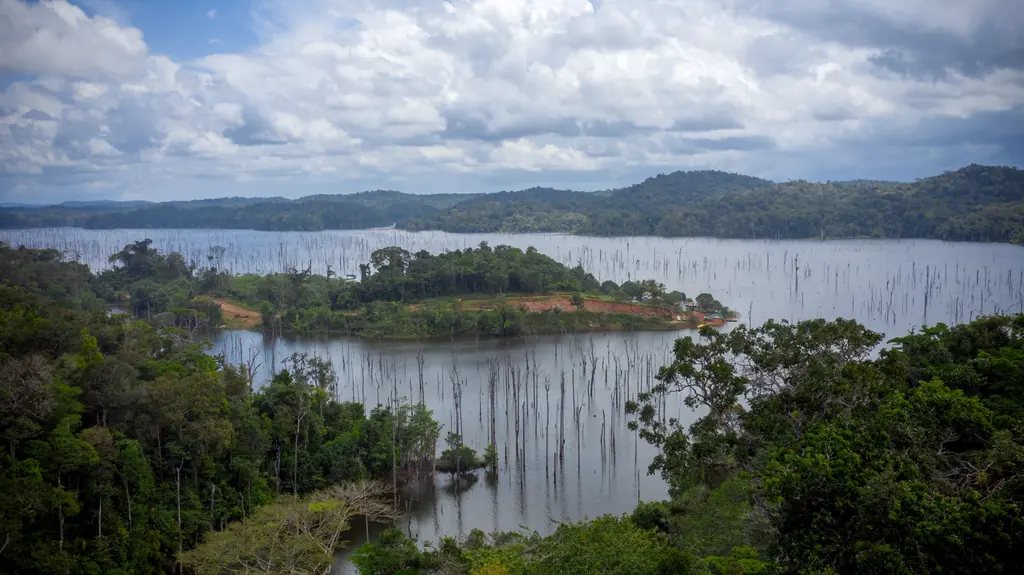
As it filled, the Petit-Saut lake isolated many islands where monkeys live. In December 2025 a researcher from the French Biodiversity Office (OFB) asked us whether a drone with a thermal camera could detect them. Trials elsewhere in French Guiana had shown that it was possible, especially early in the morning: first at Nouragues, where we had run trials with a heavy drone, then at Saül with the Amazonian Park. The first step, planned for 2026, was to fly over a few islands where primates were known to be present, to estimate the detectability rate of the method. The Guyane Conservation association, a partner in the project, funded this test operation.
Measuring the time needed for a detection
The aim was not to get a detection at all costs, but to measure the time and number of passes needed to detect, or not, a presence on an island. The OFB proposed four islands near the landing where at least one howler monkey had been seen recently, from 3 to 48 ha, between 0.9 and 3.2 km from the landing. The protocol called for a systematic sweep of each island looking for a thermal signature, with a zoom on each detection to check it. To avoid applying for a waiver to fly 2 km away, we proposed taking off from a pirogue, as close to the islands as possible.
Mammals stand out best at night and very early in the morning, when the temperature difference with the vegetation is greatest. We used a Matrice 4T drone, which combines a thermal and a visible camera and offers area sweeping and temperature-threshold alarms. The recommendations from the Amazonian Park trials were taken into account: white-hot display and a lower flight altitude over the small islands, to gain infrared resolution.
Ten flights in one night
The flights took place on the evening of 25 February 2026, at 22:14 and 22:43, then on 26 February from 04:31 to 07:56: ten flights in all. Detected primates were pinned in flight. On 2 March we delivered three videos per flight, thermal, visible in 4K and the pilot’s live screen, with a KML file of the primate positions and the flight logs, readable in log-viewing software. A short summary video in the OFB’s colours followed in mid-March.
Next steps
The research team retrieved all the videos to analyse them with thermal imaging software, before deciding on the next stage of the programme on the lake islands.