
Peti dam: 4,052 cracks tracked from one campaign to the next since 2022
Four annual campaigns on an arch dam in Minas Gerais: a baseline of 4,052 cracks surveyed at 0.8 mm per pixel in 2022, then only what appears, lengthens or becomes more visible.
Background
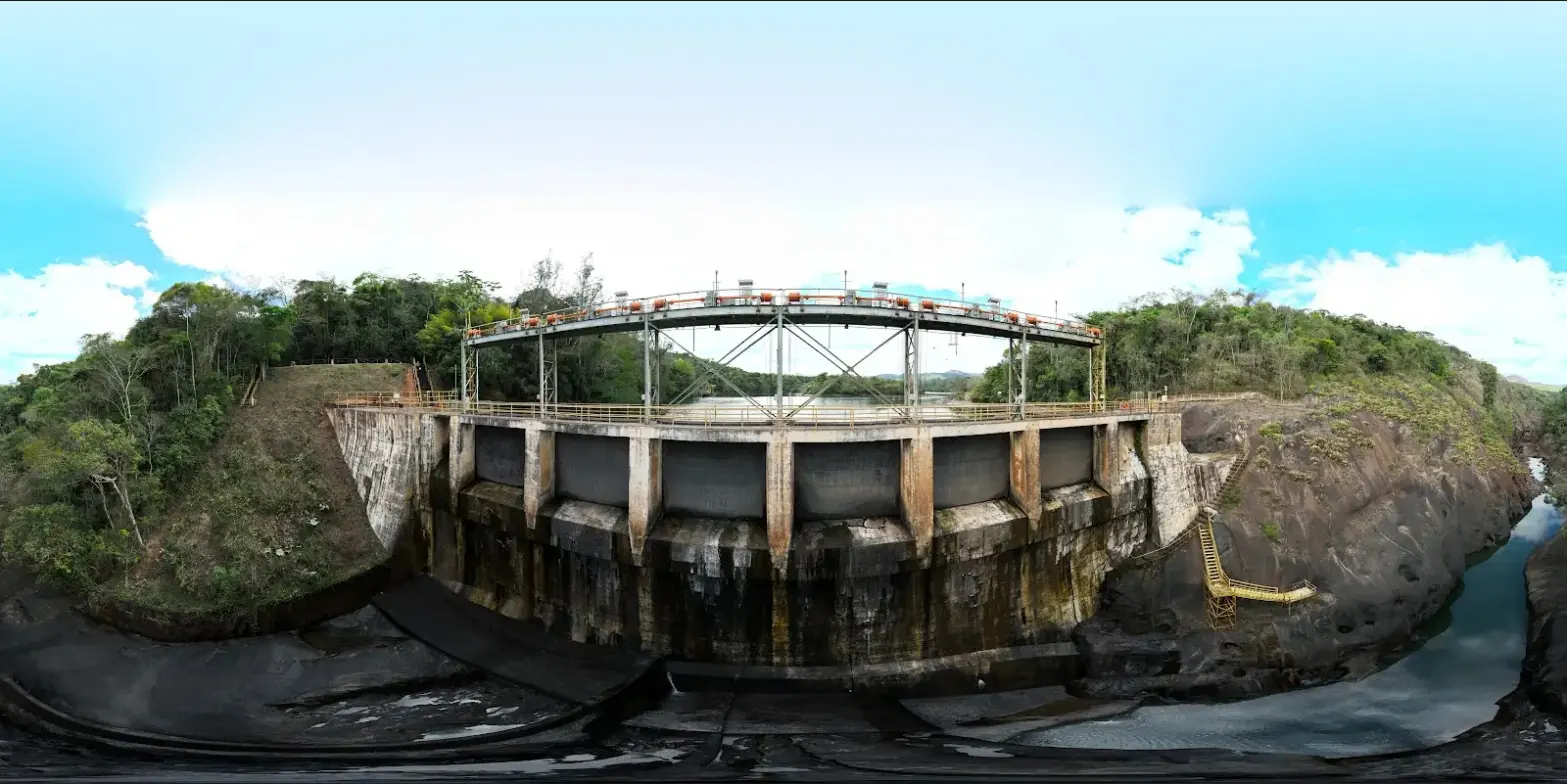
Built in 1944-1945 on the Santa Bárbara river, about a hundred kilometres from Belo Horizonte, the Peti arch dam feeds a 9.4 MW plant operated by Cemig. Its concrete is affected by alkali-aggregate expansive reactions; following an external study in 2019, the operator added drone inspection of the upstream and downstream faces and the crest to the dam’s safety plan. It needed a complete baseline of the downstream face, then campaigns that could be strictly compared from one year to the next.
What we did
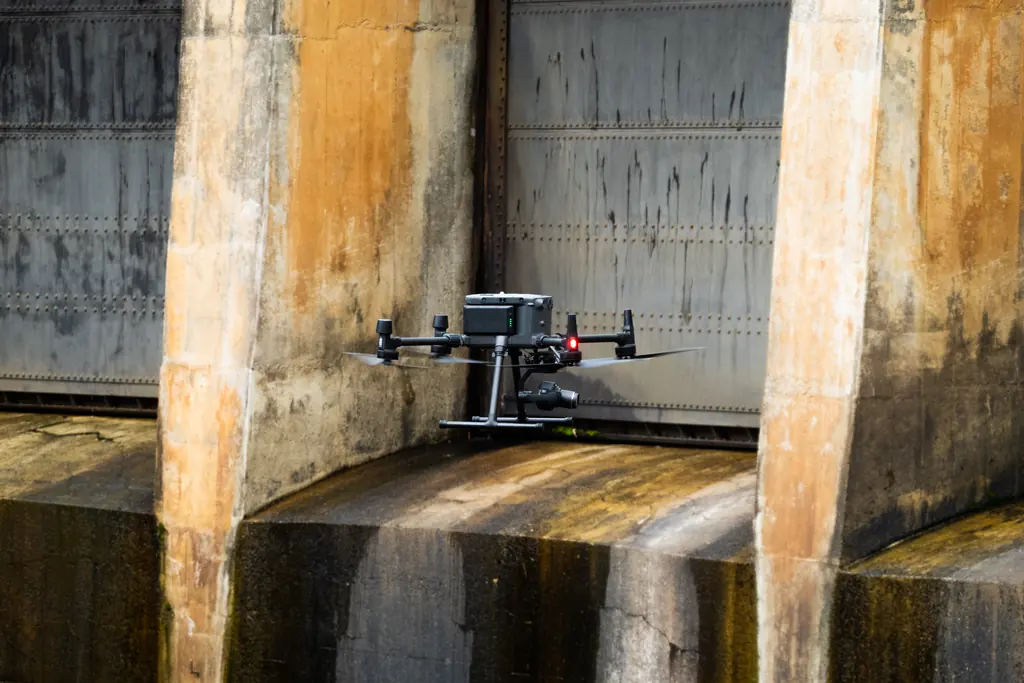
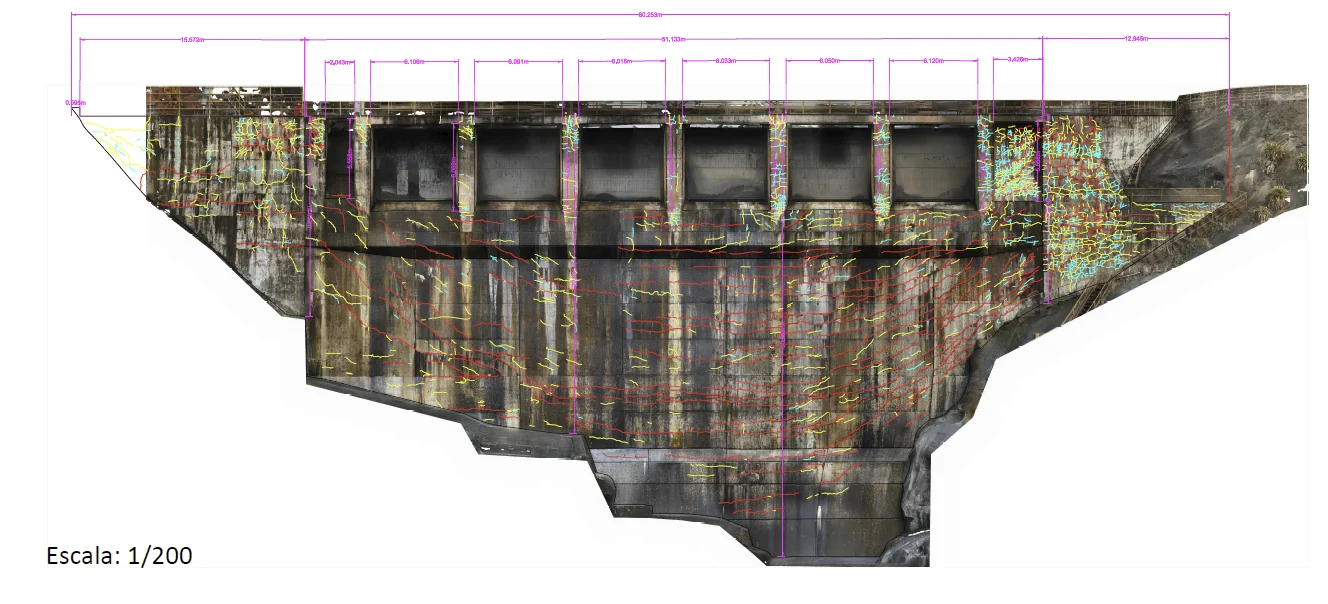
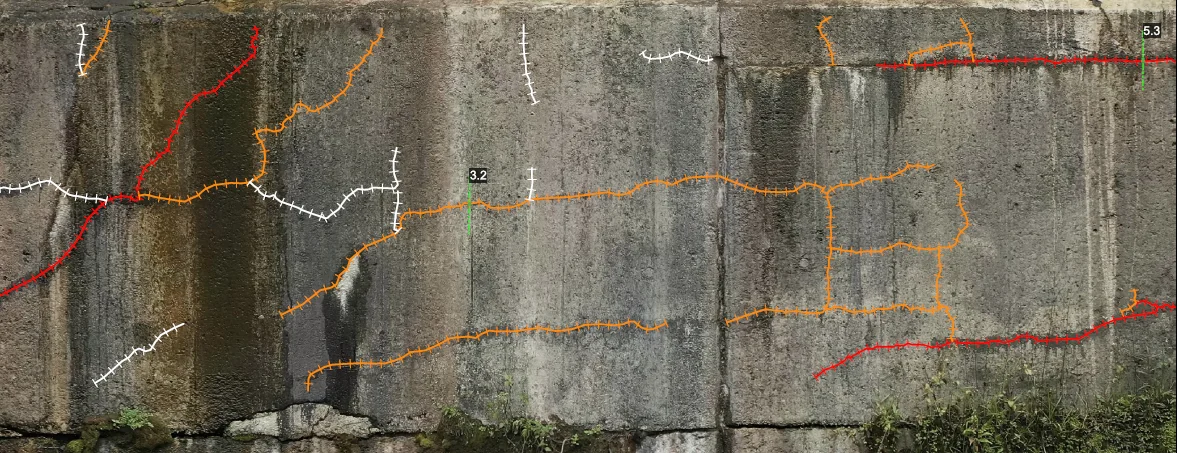
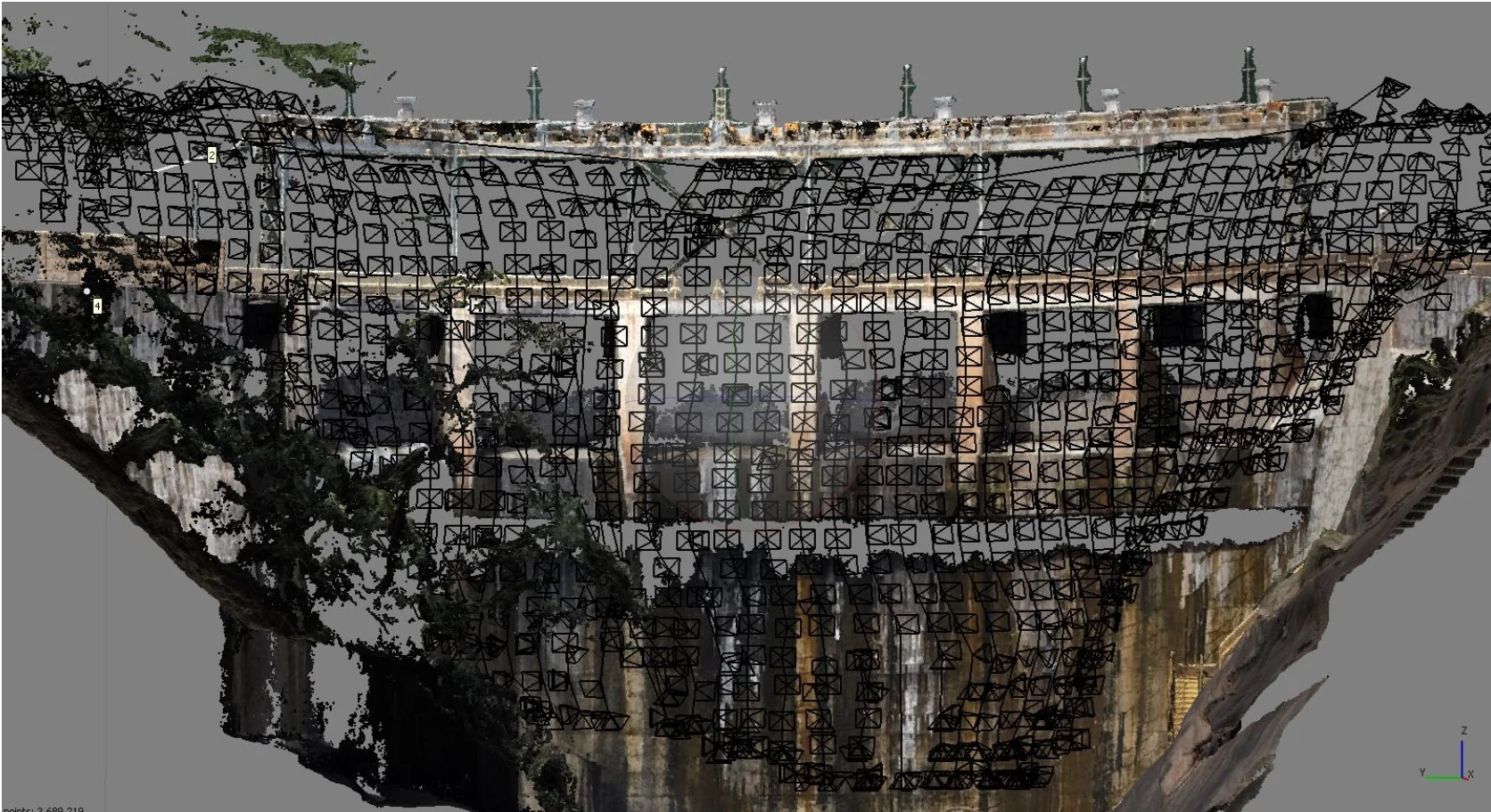
In September 2022, a multirotor RTK drone with a 45-megapixel full-frame sensor flew a general survey of 932 photos, then a 3D flight plan of 1,400 photos 6.5 m from the downstream face, computed on the model: 0.8 mm per pixel. The photos were reprojected onto three face orthophotos, one cylindrical for the arch and two planar for the side blocks, on which 4,052 cracks were drawn and classified into three families by opening and length, 2,023 m in total. At each following campaign the GNSS base goes back on the same concrete benchmark on the left bank, the face orthophotos are produced on identical projections and registered on control points of the face, and only two categories are drawn: new or longer cracks, and cracks or sections that have become more visible. A compact RTK drone, flown manually, covers the upstream face and hard-to-reach areas. This picked up 22 new or longer cracks in 2023, 4 in 2024 and 6 in 2025; the 2025 report concludes that the downstream face has remained stable since monitoring began.
3 related missions in the log
Fourth campaign on the Peti dam
From 22 to 24 September 2025: 2,037 photos in 21 flights and 12.7 km flown, 7 orthophotos totalling 3.9 gigapixels, 71 plates including 68 comparison plates; six new or longer cracks since 2024, downstream-face stability confirmed since the 2022 baseline.
- 2 037 photos
- 6 new cracks
Third campaign on the Peti dam
From 26 to 28 August 2024: 1,610 photos of the downstream face and 832 of the upstream face from 5 m away, 2023 and 2024 campaigns registered on the 2022 reference; four new cracks, cumulative length almost unchanged.
- 4 new cracks
Second annual campaign on the Peti dam
From 12 to 15 September 2023: 1,649 photos of the faces from 6.5 m away, face orthophotos registered on the 2022 baseline (4,052 cracks); 22 new or longer cracks and 54 more visible ones recorded.
- 22 new cracks
- 0,8 mm per pixel
Gallery
Other projects
Hydroelectric plant on the São Francisco river: 2,492 anomalies mapped in three days on site
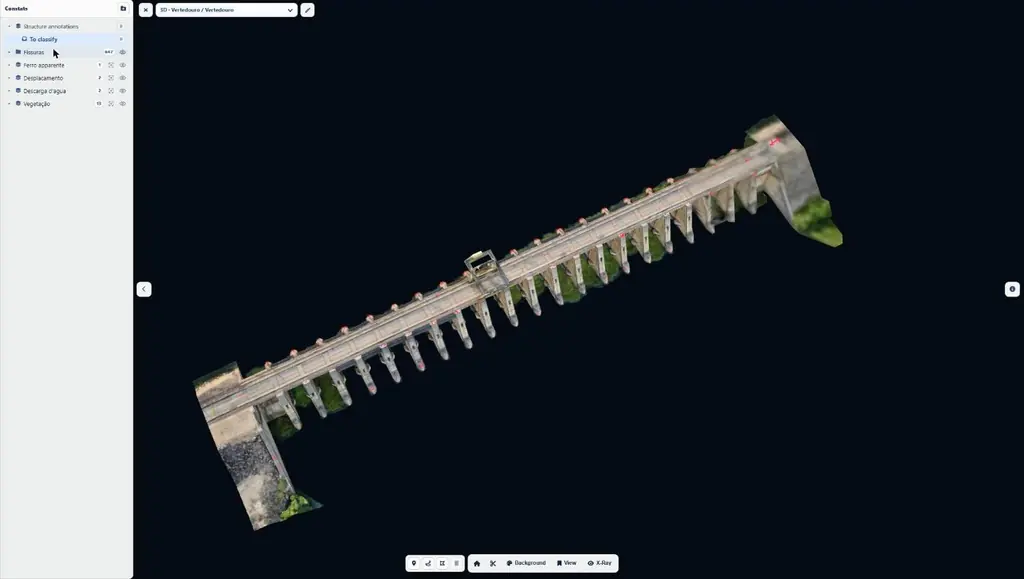
Baseline survey of a hydroelectric plant on the São Francisco river, in the state of Bahia: 11,809 photos in 33 flights, 9 orthophotos totalling 46 gigapixels, two 3D models, a virtual tour and a web interface for the operator’s engineers.
Juquiá complex: seven dams with crests of 140 to 265 m
Two-year contract signed in July 2026 with an energy producer: the seven dams flown over in August, the faces of Salto do Iporanga and then Serraria surveyed in detail, the rest scheduled for the 2027 dry season.
Furnas test blocks: cracks measured at 0.15 mm per pixel
For Furnas’ research programme on concrete affected by expansive reactions, face-by-face measurement of the cracks of 80 cm test cubes: 26 blocks in 2022 at 0.25 mm per pixel, 14 blocks in 2023 at 0.15 mm.
Tell us about your project
Location, area or structure, expected deliverables and timing: with these details we can propose a method and a quote.
97310 Kourou
French Guiana
Route des Trois-Îlets
97229 Les Trois-Îlets
Martinique
20030-041 Rio de Janeiro – RJ
Brazil